We're All Starting to Sound Alike
The New York Times Magazine recently published "Why Does A.I. Write Like … That?" — an examination of why AI writes the way it does, and those recursive patterns of phrasing that have become algorithmic signatures.
The argument is pointed: AI writing isn't smooth or neutral. It's weird. It has developed its own unmistakable rhetorical quirks and now humans, consciously or not, are adopting them in return.
We are starting to sound like the machines we taught to sound like us.
There is a certain homogenization creeping into the prose we encounter online, a flattening of voice into something that gestures toward depth without quite achieving it. Prose that is grammatically clean, structurally sound, and somehow completely empty.
But the bigger question isn't about vocabulary or grammar. It's about whether people can recognize when the output they're receiving is fundamentally subpar — and more pressingly, whether they care.
On Using It Well
None of this is an argument against AI in writing workflows. But there is a meaningful difference between using it as a tool and using it as a ghostwriter for your own thinking — and most people have stopped drawing that line carefully.
Good writing, in any context, requires someone in the room who knows the difference. AI cannot be that person. It can only simulate having been one.
The tell is in the question the tool eventually asks: Do you want to sound better? That question contains the algorithm's entire premise — that "better" means closer to the statistical average of professional English prose it was trained on. Better for whom? Better according to what standard? Better than what you actually meant to say?
The Language I Rebuilt
There's a more personal dimension to this that deserves acknowledgement.
I came to this country without speaking English. When I was younger — before the move, before the ocean between me and the language I grew up in — I wanted to be a poet. That was the passion. Words were the thing.
What happens when you move countries is that language becomes a weight you carry differently than you did before. Words you knew with your whole body suddenly require effort. The instinct to reach for a phrase and the ability to find it become briefly, sometimes permanently, misaligned. I did not stop wanting to write. But I had to rebuild the instrument I wanted to write with, and that takes time, and it costs something that is hard to name.
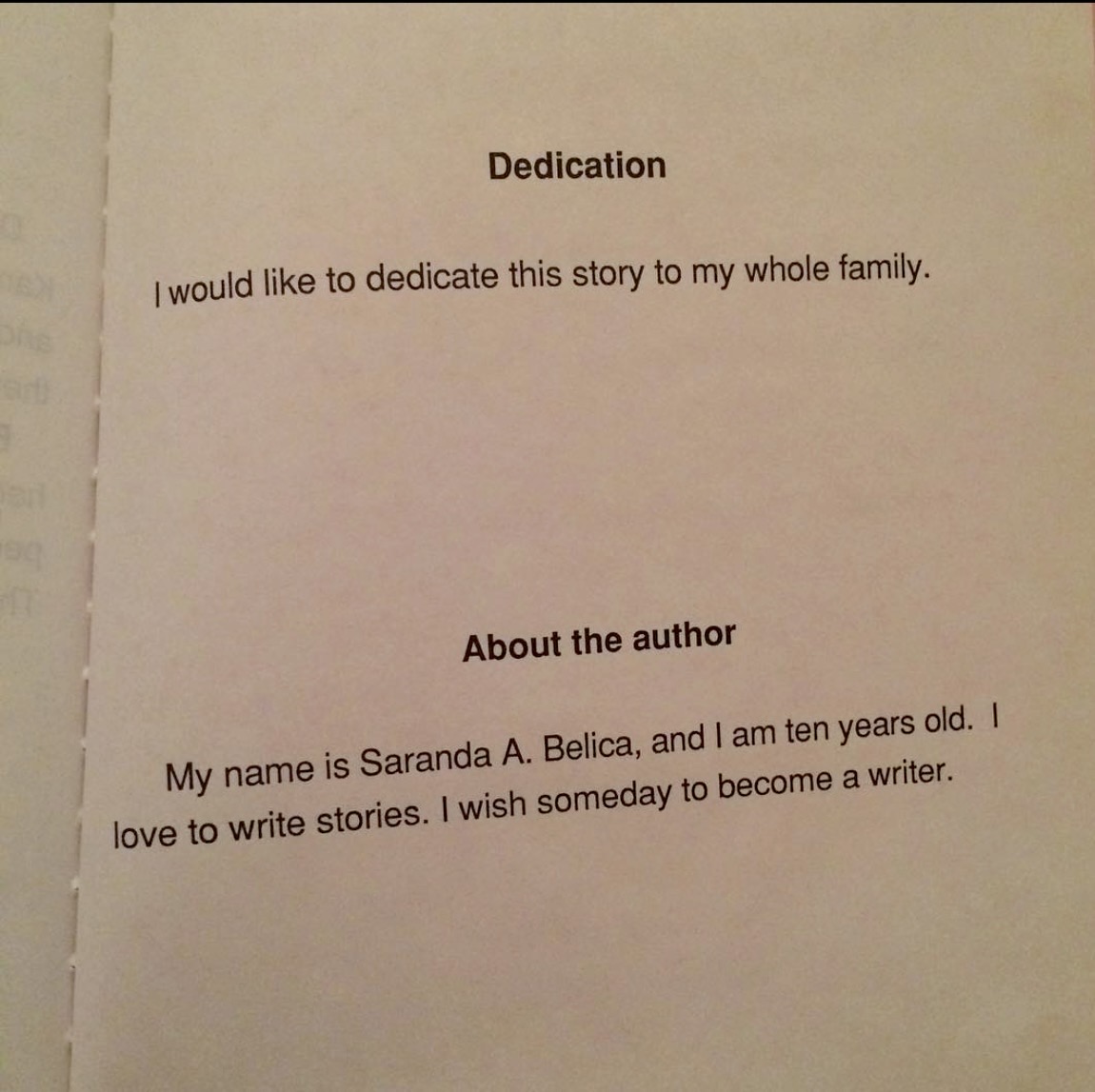
Age 10. I don't have a middle name but I gave myself one. The Little Mermaid made it seem non-negotiable.
AI initially offered genuine help. Grammar correction, structural suggestions — these applications addressed real needs and created real improvement. The technology served as a supportive editor, helping me strengthen my command of English without erasing my voice.
But the tool that once helped me find my voice is now, if you let it, in the business of replacing it. The same capability that corrected my grammar will, if you lean on it too far, sand away the particular texture of how I think.
I came to this country without words and spent years building them back. I am not interested in outsourcing them now.
And I think about what it means that the field I now work in — the one shaping how these tools develop and who gets access to them — is the same field that has to reckon with what we lose when we hand language over too completely. I did not cross an ocean and rebuild a language to let an algorithm flatten it into the mean.
The Standard Worth Keeping
The question isn't whether AI can write competently enough to fool us. Clearly it can, at least some of the time, at least for some purposes. The question is whether we're going to maintain the standards and the attention required to notice the difference — and whether we're going to insist that the difference matters.
That insistence is a choice. It requires developing and defending a standard at a moment when the path of least resistance is to let the standard quietly erode. It requires caring about voice — your own and other people's — as something worth preserving rather than optimizing.
I work every day on what the future of work looks like. I think about who gets left behind and who gets lifted. I think about the tools we're building and the capacities we're building them on top of. And I keep coming back to the same uncomfortable thought: the most human thing about human work has always been the judgment, the voice, the particular way a specific person sees a problem and puts words to it. If we outsource that — not because we have to, but because it's easier — we will not get it back easily. And we will not immediately notice it's gone.
The words are worth keeping. So is the standard required to keep them.